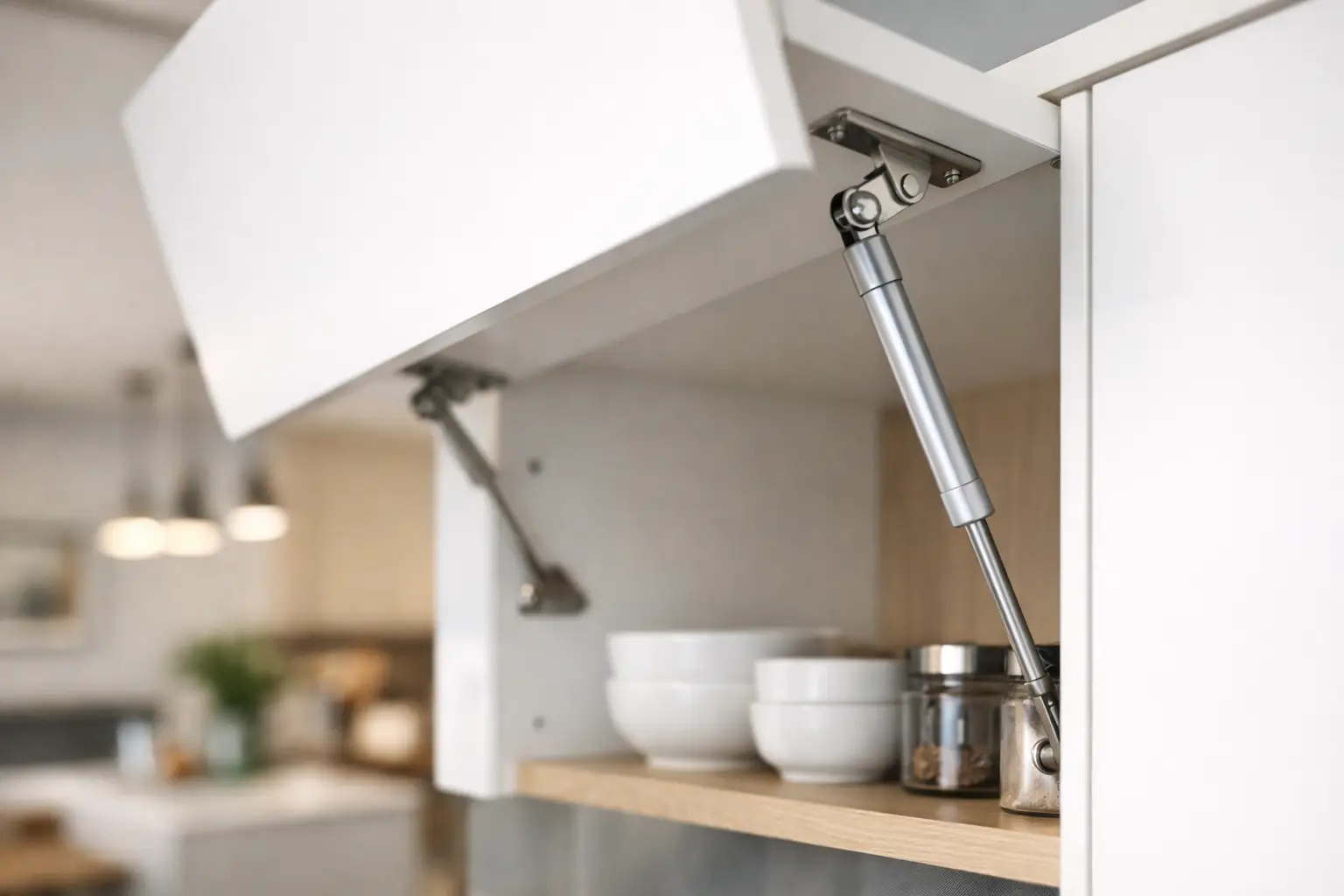
A cabinet lid that won’t stay open is more than annoying. In a workshop, caravan, boat or service body, it slows the job down and can become a safety issue fast. Choosing the best petrol struts for cabinets comes down to more than picking a pair that looks about right. The right strut has to match the lid weight, opening angle, mounting geometry and how the cabinet is actually used.
That matters because cabinet struts are often treated as a generic item when they are anything but. A lightweight overhead pantry door, a toolbox lid and a heavy access hatch may all look similar, but they demand different force ratings, stroke lengths and end fittings. If the strut is too weak, the lid drops. Too strong, and it can twist hinges, stress fixings or make closing the cabinet harder than it should be.
What makes the best petrol struts for cabinets?
The best option is the one that suits the application properly and keeps working under repeated use. For cabinet applications, that usually means stable lift assistance, controlled movement, reliable holding force and hardware that resists wear in the environment it is installed in.
Build quality matters. A cabinet strut might be opened dozens of times a day, particularly in trade vehicles, commercial fit-outs or industrial enclosures. Better petrol struts hold pressure consistently, resist seal failure and use durable finishes on the rod and tube. That becomes even more important where there is dust, vibration, salt exposure or temperature variation.
It is also worth looking at how the strut mounts. The best cabinet installation is not just about the strut itself. End fittings, brackets and ball studs all need to suit the available space and load path. A quality strut fitted with the wrong bracket can still produce poor movement or early failure.
Cabinet type changes the right strut
There is no single answer to the best petrol struts for cabinets because cabinet design varies a lot. Small overhead flap doors usually need low-force support and precise placement. Large horizontal lids often need more force and careful balancing across a wider span. Side-opening panels may need a different motion control approach entirely.
In caravans and campers, the usual priority is compact fitment and smooth movement in tight spaces. In workshop cabinets and service vehicles, strength and durability often matter more than compactness. In marine cabinets, corrosion resistance moves much higher on the list. The right strut depends on where the cabinet lives and how hard it is worked.
If the cabinet door is heavy or unusually shaped, a standard stocked strut may not be enough. That is where a custom-specified solution can save a lot of trial and error. Matching the strut to the real load and geometry is usually cheaper than replacing bent hinges or redoing a poor installation later.
Force rating matters more than most buyers expect
Force is usually measured in Newtons, and it is one of the first specifications to get right. Many cabinet issues come back to incorrect force selection. People often assume the lid weight alone determines the rating, but that is only part of the picture.
The mounting position changes the leverage dramatically. A strut mounted closer to the hinge needs a higher force to hold the same door than a strut mounted further away. The opening angle also affects how the load behaves through the movement. A lid that feels manageable by hand can still require a stronger strut than expected if the geometry works against it.
Too much force creates its own problems. It can cause the cabinet to spring open too aggressively, put extra load into hinges and make the door difficult to latch closed. For lighter cabinet doors, a lower-force strut that gives controlled assistance is often the better result.
When two struts are better than one
For wider or heavier lids, using a pair of struts usually gives better balance and less twisting. This helps reduce uneven stress on hinges and keeps the lid tracking properly. One strut can work on some narrow cabinets, but once the lid gets wider or heavier, a matched pair is usually the safer and more durable choice.
That said, two struts are not automatically better if the cabinet is small. On a lightweight panel, a pair can add more force than needed and make closure awkward. It depends on the size, weight and available mounting positions.
Size, stroke and extended length
A strut that is physically the wrong size will never work properly, even if the force rating is close. For cabinet fitment, the key dimensions are usually extended length, compressed length and stroke.
Extended length is the eye-to-eye or centre-to-centre measurement when the strut is fully open. Compressed length is the same measurement when fully closed. Stroke is the distance the rod travels between those two points. These numbers determine whether the door opens to the required angle and whether the strut fits inside the cabinet without bottoming out or overextending.
This is why measuring the old strut, if one is fitted, is useful but not always enough. If the previous installation was poor, simply copying it can repeat the same fault. It is better to confirm the actual opening angle, hinge position, lid dimensions and available mounting points before ordering a replacement.
Materials and finish for cabinet environments
Indoor cabinetry in a dry setting places different demands on a strut than a toolbox on a ute tray or a hatch in a coastal marine fit-out. Standard finishes may be fine for clean internal use, but harsher environments need better corrosion resistance and stronger sealing performance.
Where moisture, salt or road grime are part of the job, material choice matters. Surface protection on the cylinder and rod helps prevent premature wear, while better seal design helps maintain pressure over time. For cabinets in mobile applications such as caravans, trailers and service bodies, vibration resistance also deserves attention.
This is one of those areas where buying purely on price often costs more later. A cheaper strut may fit and function at first, but if it loses pressure quickly or corrodes around the rod, replacement cycles shorten and reliability drops.
Brackets and fitment are part of the result
Even the best petrol struts for cabinets will disappoint if the brackets are poorly chosen or incorrectly placed. Bracket style affects clearances, opening angle and the way force is transferred into the cabinet frame and lid.
Ball joint fittings are common because they allow some angular movement through the opening cycle. That flexibility helps reduce side load on the strut. Fixed mounts can work in some layouts, but they leave less room for alignment error. If the strut is forced to operate on an angle it was not designed for, seal wear and rough movement usually follow.
The cabinet structure matters too. Thin panels may need reinforcement where brackets are mounted. Heavy struts fixed into weak substrate can pull out over time, especially in mobile or high-vibration setups.
How to identify the right replacement
If you are replacing an existing cabinet strut, gather the strut markings first. Part numbers, force rating in Newtons and basic dimensions can speed things up. Then check the end fittings and bracket style, because two struts with similar body sizes can still mount differently.
If there is no readable part number, measure the extended and compressed lengths, note the stroke if possible, and record where the strut is installed. Photos of the open and closed positions help. So do lid dimensions and an estimate of the lid weight. For unusual cabinets, details about material, hinge location and desired opening angle make a big difference.
For new cabinet builds, it is worth starting with the application rather than trying to force a standard size into the job. A proper specification takes into account the lid weight, centre of gravity, mounting distances and how far the door needs to open.
When standard struts are enough and when custom is smarter
Many cabinet applications can be solved with standard petrol struts if the measurements line up and the operating conditions are straightforward. This suits common overhead doors, access panels and lightweight lids.
Custom becomes the better option when the cabinet is heavy, space is tight, the opening motion is unusual or the environment is demanding. It also makes sense where the cost of failure is higher, such as commercial vehicles, industrial access doors or equipment housings that are opened frequently.
For buyers who need dependable supply and technical help, working with a specialist supplier makes the process faster. Petrol Struts supports both standard replacements and application-based solutions, which is often the difference between a quick fit-up and a long round of trial parts.
Buying with fewer mistakes
The simplest way to avoid getting the wrong cabinet strut is to treat it as a fitment problem, not just a parts purchase. Measure carefully, check the force, look at the brackets and think about the environment. If the cabinet is used hard, exposed to weather or carries a heavy lid, build quality should sit ahead of bargain pricing.
A cabinet should open cleanly, stay open reliably and close without a fight. If that is the goal, the best choice is rarely the cheapest or the most powerful. It is the strut that is properly matched to the job and built to handle the way the cabinet is actually used.
If you are unsure, the most useful next step is not guessing a part number. It is collecting the measurements and application details that let a specialist point you to a strut that will work first time.