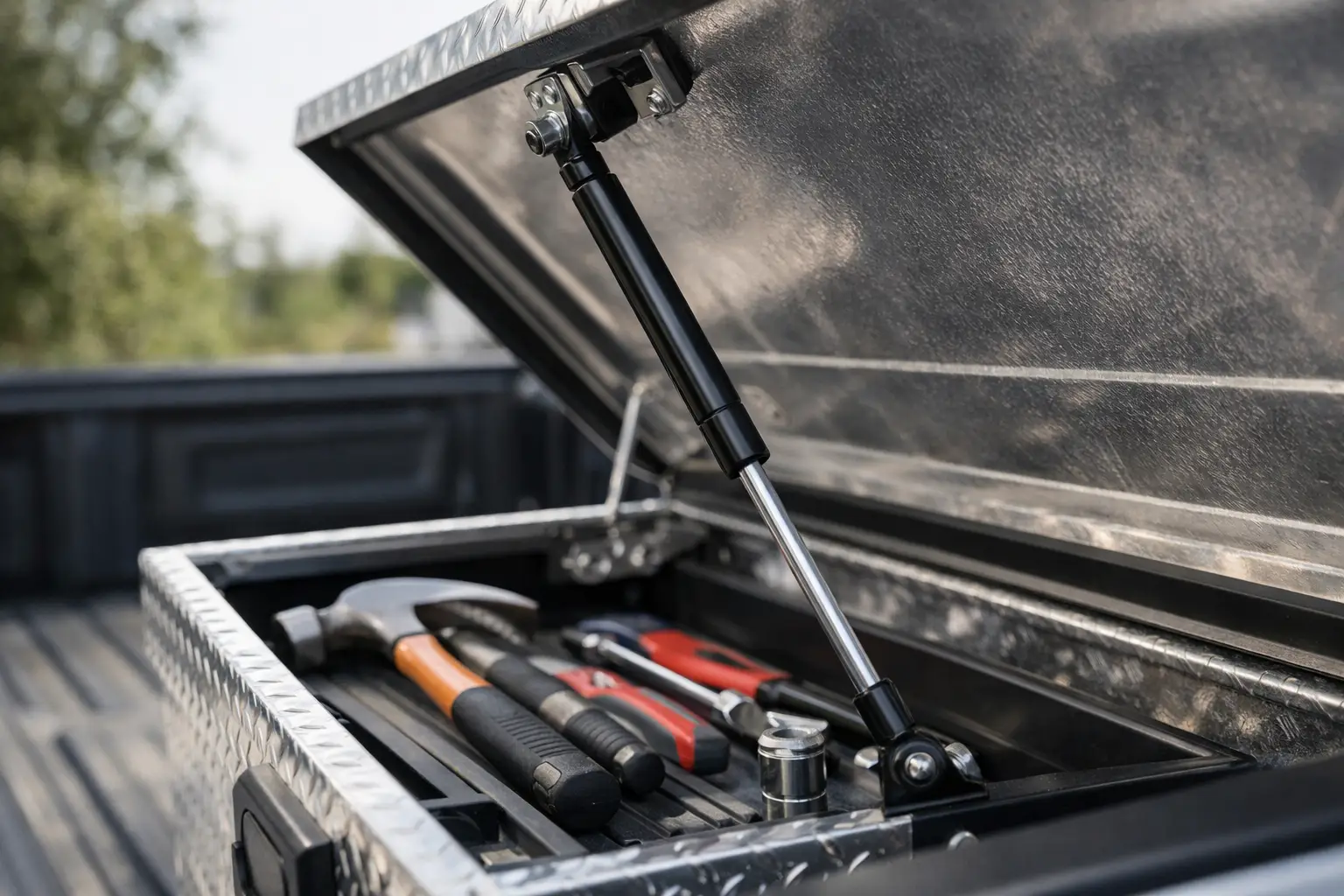
A toolbox lid that drops without warning is more than annoying – it slows the job down, damages hinges and turns a simple grab-and-go into a safety issue. Choosing the best petrol struts for toolboxes comes down to more than buying a pair that looks about right. Force, stroke, mounting geometry, lid weight and the working environment all affect whether the lid lifts cleanly or fights you every time.
For tradespeople, fleet operators and workshop managers, the right strut does two jobs at once. It supports the lid safely and it protects the toolbox structure from repeated shock loading. A poor match might still open the lid, but it can twist the hinges, over-extend the mounts or lose pressure early if the strut is underspecified for heat, dust or frequent cycling.
What makes the best petrol struts for toolboxes?
The best option is not always the strongest strut on the shelf. In most toolbox applications, a strut needs to control the lid through the full opening arc without making it hard to close. If the force is too high, the lid can spring up aggressively and put extra load into the hinge line or body. If the force is too low, the lid may not stay open in wind, on uneven ground or when the box is mounted on a trailer or ute tray.
A good toolbox strut should match the lid weight and dimensions, suit the mounting points available, and hold up in harsh service. Material quality matters here. Seals, rod finish and end fittings all influence service life, especially where the box is exposed to moisture, corrugations, washdowns or fine dust.
This is why a direct replacement based only on length can be risky. Two struts with similar extended length can behave very differently if their force rating, compressed length or mounting style is wrong.
Start with the application, not the part number
Toolbox lids vary more than many buyers expect. A crossover toolbox on a ute, an under-tray box, a site box in a workshop and a checkerplate trailer box all place different demands on the strut. Lid size, hinge placement and how often the box is opened each day all matter.
For a light aluminium lid, a lower force strut may be enough even with a wide opening angle. For a heavy steel lid, or one carrying internal liners, racks or seals that increase closing resistance, a heavier force rating may be needed. Side-opening and top-opening boxes also behave differently because the centre of gravity shifts in a different path as the lid opens.
If the toolbox is mounted on mobile equipment, there is another factor – vibration. A strut that performs well in a stationary cabinet may not last as well on a trailer, service body or agricultural machine without the right quality level.
How to choose the right toolbox gas strut
The safest way to select a strut is to look at the full set of measurements and operating conditions. Extended length is only one part of the picture.
Measure extended and compressed length
Measure the existing strut from centre of fitting to centre of fitting when fully open and when closed, if the old strut is still intact. If the strut has failed or is missing, measure the distance between mounting points with the lid open and closed. This tells you the likely working envelope.
The strut must not bottom out before the lid closes. If it does, something else will give first – usually the bracket, hinge or lid skin. It also must not over-extend the lid beyond the hinge’s intended travel.
Check the stroke
Stroke is the difference between extended and compressed length. It needs to suit the opening arc of the lid. Too little stroke can limit opening. Too much can create poor geometry and unstable support through the middle of travel.
Confirm the force rating
Force is usually measured in Newtons. This is where many toolbox replacements go wrong. Buyers often assume a stronger strut is safer, but over-forcing the lid can create closing difficulty and long-term stress on the box.
As a guide, the right force depends on lid mass, lid dimensions, hinge position, mounting angles and whether one or two struts are used. A wide lid with mounts set close to the hinge generally needs a different force than a narrow lid with mounts further out. If the lid has changed due to added racks, internal storage or accessories, the original strut rating may no longer be correct.
Match the end fittings and brackets
Ball joints, eyelets and fork ends are not interchangeable unless the bracket arrangement allows it. Even where threads match, articulation angle can differ. A strut that binds at the fitting will wear out early and may pop off under load.
Consider the environment
Toolboxes on utes, trailers and plant equipment deal with sun, dirt, water and vibration. In those conditions, seal quality and rod protection matter. For buyers who need dependable service rather than a short-term fix, component quality should be part of the decision, not an afterthought.
When a standard replacement works – and when it doesn’t
A standard replacement is often the quickest and most cost-effective option if the original strut size, force and fittings are known and the toolbox itself has not changed. This is common for factory-fitted ute boxes, service bodies and workshop storage where the geometry is proven.
Custom sizing becomes the better path when the original part is unavailable, the mounts have been relocated, the lid has been modified or the box was a one-off fabrication to begin with. It also makes sense when the lid behaviour was never right in the first place. If the old setup slammed shut, needed two hands to close or only stayed open on level ground, copying it exactly may just repeat the problem.
That is where specialist guidance saves time. A proper assessment can account for the lid weight, opening angle and bracket position before a replacement is supplied.
Common problems with toolbox struts
A toolbox strut usually gives some warning before complete failure. The lid may drift down slowly, lift unevenly or stop short of full opening. In paired strut setups, one weak unit can make the lid twist, which increases stress on hinges and mount points.
Temperature can also affect performance. Petrol struts generally feel firmer in hotter conditions and weaker in colder conditions. For most toolbox applications this is manageable, but if the lid is marginal already, seasonal changes can be enough to expose the issue.
Another common problem is fitting a new strut to worn hardware. If the brackets are bent or the hinge line is misaligned, even a quality strut will not perform properly. It pays to inspect the full setup rather than treating the strut as the only moving part.
Best petrol struts for toolboxes in heavy-use settings
In heavy-use settings, the best petrol struts for toolboxes are the ones selected for the actual load and duty cycle, not just general fit. Workshop boxes opened all day need consistency over repeated cycles. Mobile toolboxes on service vehicles need vibration resistance and secure mounting. Agricultural and mining applications often need extra attention to contamination, shock load and component durability.
For trade and industrial buyers, quality assurance matters because downtime costs more than the part. A strut built to recognised manufacturing standards, with dependable sealing technology and consistent force output, reduces the risk of premature replacement. That matters even more when the toolbox holds critical gear or is mounted where unsafe access is a risk.
This is also why a two-year warranty and access to technical support are worth factoring in. A low-cost generic strut can look similar on paper, but if it lacks consistency in force or finish quality, the service life may be short.
What to have ready before ordering
If you want the right replacement the first time, gather the practical details before you enquire. Extended length, compressed length, stroke, force rating, end fitting type and where the toolbox is used are the key basics. Photos of the open and closed lid position also help clarify mounting geometry.
If there is no readable part number, the next best information is the lid size, approximate lid weight and whether one or two struts are fitted. Mention any modifications, such as added seals, internal shelving or heavier skins. These details change the force requirement more than many people realise.
For buyers who are replacing struts across multiple vehicles or site boxes, consistency is just as important as fitment. Standardising the correct unit across a fleet can make future maintenance simpler and reduce mismatched installs.
A toolbox should open smoothly, stay where it is meant to stay and close without a fight. If your current setup does not do that, the issue is usually not complicated – it just needs the right measurements, the right force and advice from someone who works with struts every day.