
A hatch that feels heavy halfway through its travel, a toolbox lid that will not stay open, or a canopy door that lifts too hard are all signs that the strut specification needs checking. To measure gas strut force properly, you need more than the weight of the lid. The mounting position, centre of gravity, opening angle and number of struts all affect the force required.
A gas strut is not simply a spring measured against the total load. It works through leverage. Getting that leverage wrong can leave a lid unsafe to operate, damage hinges, or make the struts difficult to compress when closing.
Start with the existing strut rating
For a replacement strut, the fastest starting point is the force marked on the original cylinder. This is normally shown in Newtons, written as N. Common examples include 250N, 450N, 700N and 1200N. One kilogram-force is approximately 9.81N, so a 500N strut provides roughly 51kg of force at the rod, not 500kg of lifting capacity.
Read the marking carefully. It may be printed directly on the tube, etched into the cylinder, or included in the part number. The force rating is often followed by the extended and compressed length, such as 600mm x 350mm, or by a manufacturer code.
Matching the marked Newton rating is usually suitable where the replacement uses the same mounting points, lid, hardware and orientation. However, do not assume an existing strut was correctly specified. Previous repairs may have used an unsuitable unit, especially where the lid has been modified, lined, fitted with accessories or repaired after damage.
Measure gas strut force from the application
When no usable rating is available, calculate the force requirement from the application. This is the right approach for a custom toolbox, machinery guard, boat hatch, caravan bed base, trailer lid or industrial enclosure.
First, weigh the moving panel. Remove anything that does not move with it, but include handles, locks, internal lining, spare-wheel mounts, gas bottles, windows or accessories that travel with the lid. For large or awkward panels, support the load safely and use scales or a load cell rather than estimating by hand.
Next, locate the panel’s centre of gravity. On a plain rectangular lid with even construction, it is often near the middle. It will move towards heavier fittings on an uneven load. This matters because the centre of gravity determines the turning force, or moment, trying to pull the panel closed around its hinge.
The calculation uses two moments:
- the closing moment created by the panel weight acting through its centre of gravity
- the opening moment created by the gas strut acting through its mounting geometry
In simplified form, the force required per strut is:
Strut force = panel weight × weight lever arm ÷ strut lever arm ÷ number of struts
Use Newtons for weight and metres or millimetres consistently for both lever arms. The weight lever arm is the perpendicular distance from the hinge pivot to the vertical line through the centre of gravity. The strut lever arm is the shortest perpendicular distance from the hinge pivot to the strut’s line of action.
That last measurement is where many calculations go wrong. Measuring from the hinge to the ball stud does not give the working lever arm unless the strut is positioned at exactly 90 degrees to that line. As the lid opens, the strut angle changes and so does the available leverage.
Check the hardest part of the travel
A lid generally needs the greatest assistance near the closed position, where the strut has the least useful leverage. It can also need support near full opening if it must remain safely open against minor vibration or a reasonable breeze.
Calculate or test the arrangement at several positions, particularly just after lift-off, halfway open and at the intended open stop. A strut that performs well in the middle of travel may still be too weak to start lifting the panel. Conversely, one selected only for the closed position may be overly strong at full extension.
For a one-off fabrication, a practical test arrangement can be useful. Support the panel securely, then use a spring scale or load cell at the planned mounting point and direction to identify the force needed to hold or slowly raise it. Keep fingers clear of pinch points, use rated temporary supports, and never rely on a test strut as the only support for a heavy lid.
What a force tester can and cannot tell you
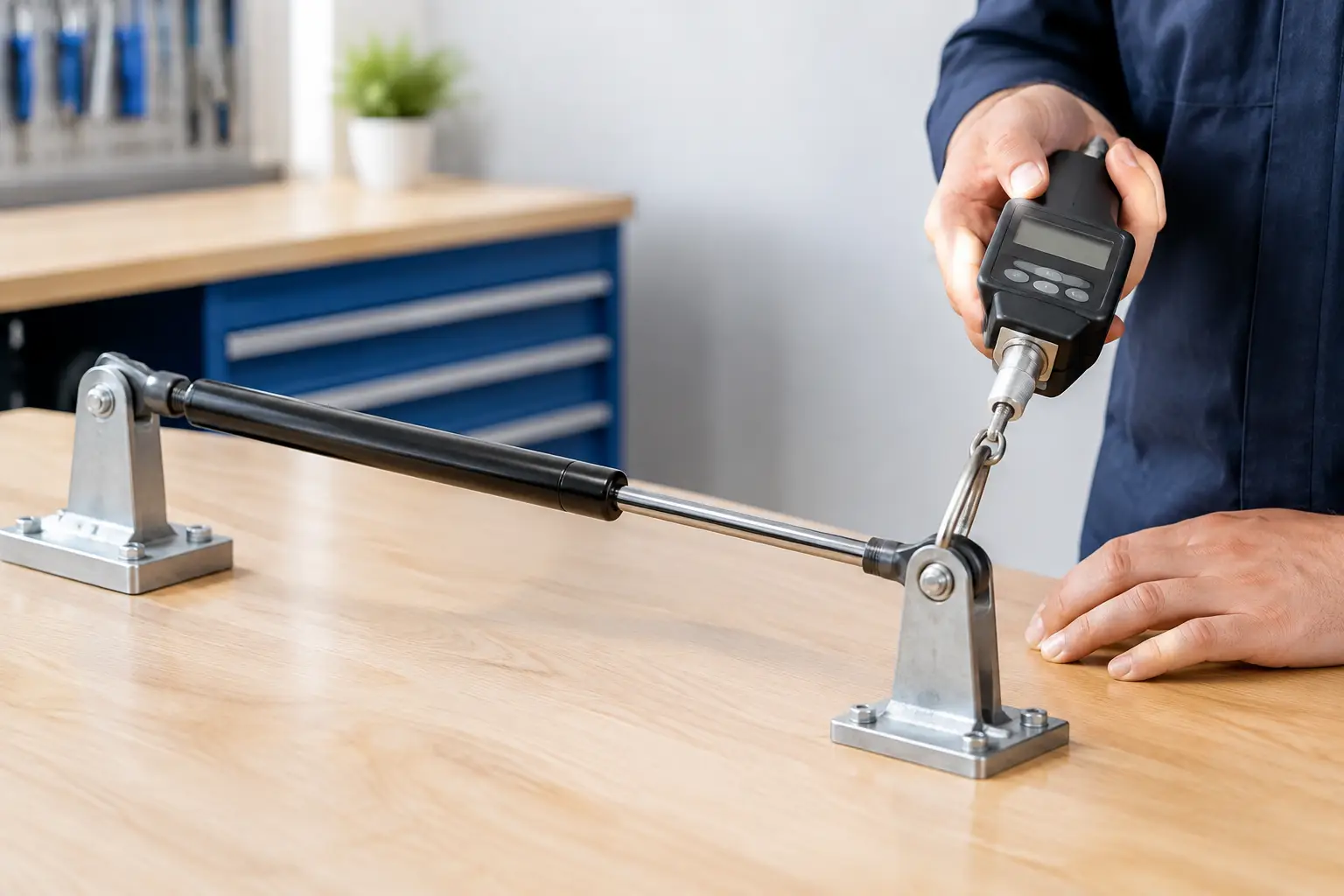
A proper gas strut force tester measures the extension force directly as the rod moves at a controlled speed. This is the most accurate way to verify a strut’s actual output, and it is useful in workshop, maintenance and quality-control settings.
The test should be done at a stated rod position and temperature. Gas pressure changes with temperature, so a strut tested on a hot summer afternoon can show more force than one tested cold. Gas struts also produce a slightly different force through their stroke because the gas volume changes as the rod enters the cylinder.
A bathroom scale, luggage scale or hand test is not a reliable way to measure the cylinder’s rated force. It may indicate that a strut has failed badly, but it cannot reproduce the correct compression position, axial alignment or controlled movement. Side loading the rod during a test can damage the seal and produce misleading results.
If the original strut has become weak, compare it with its marked rating rather than copying its current behaviour. Gas loss, worn seals and a bent rod all reduce performance. Replace damaged struts rather than attempting to regas them in the field.
Allow for real operating conditions
The calculated figure is a starting point, not an automatic final specification. A modest safety allowance is often appropriate, but more force is not automatically safer. Excess force can bend mounting brackets, strain hinges, make a lid hard to close and cause a panel to spring open unexpectedly.
The correct allowance depends on the application. A light cabinet door used indoors may need a close, controlled match. A canopy door, service body hatch or agricultural machine cover may need extra support for dust seals, friction, added equipment and outdoor use. On a marine application, account for corrosion, changing loads and the possibility of motion while moored.
Temperature also matters in Australian conditions. High ambient heat increases gas pressure and lifting force, while cold conditions reduce it. A strut that is only just adequate on a cool morning may not hold a heavily fitted hatch at the desired angle. One that is excessive in summer can be difficult to compress or place unnecessary load on hardware.
Use two struts for wide, heavy or flexible panels where possible. They distribute the load, reduce twisting and improve control. Both sides must have matching force ratings and equivalent mounting geometry. Replacing only one strut can leave the panel uneven and transfer unnecessary load into the remaining old unit.
Record the measurements needed for a correct strut
Force is only one part of the specification. Before ordering or requesting a quote, record the extended length measured centre-to-centre between the mounting points, the compressed length, and the available stroke. Also note the end fittings, such as ball sockets, eyelets, fork ends or threaded studs, and measure their thread size where relevant.
Photograph the strut markings and both mounting points. Note whether it is fitted rod-down, which is generally preferred where the design allows because it helps lubricate the seal. Record the panel type, estimated weight, number of struts, hinge position and desired open angle. These details make it far easier to identify a suitable standard replacement or design a custom arrangement.
Do not select a strut solely because it has the right extended length. A unit can physically fit yet bottom out before the lid closes, run out of stroke before it reaches the open position, or provide force at the wrong angle.
When to get specialist advice
Heavy access doors, mining equipment, machinery guards, large marine hatches and modified vehicle canopies deserve a full geometry check. The consequences of a failed or overspecified strut are greater, and mounting points may need reinforcement as well as the correct Newton rating.
For a dependable result, provide the measurements, photographs and operating requirement to a strut specialist before fitting. A correctly measured gas strut should make the panel controlled and predictable – easy to lift, secure when open and manageable to close every day.